
AI-powered omnichannel funnels
AI-Powered Omnichannel Funnels: How to Orchestrate Email, SMS, WhatsApp & Push for Better Journeys
How to orchestrate AI-powered email, SMS, WhatsApp and push notifications into coherent customer journeys—covering segmentation, deliverability, automation, and analytics.
Listen to this article
Reader's guide
This article is organised around the following topics. Use the headings below to scan the existing guidance before reading the detail.
AI-Powered Omnichannel Funnels: How to Orchestrate Email, SMS, WhatsApp & Push for Better Journeys
Delivering consistent, measurable customer journeys today means moving beyond single-channel campaigns. AI-powered omnichannel funnels combine email, SMS, WhatsApp, and push notifications with smart segmentation, automation, deliverability best practices, and analytics so you reach the right person with the right message at the right time.
Why omnichannel funnels — and why AI?
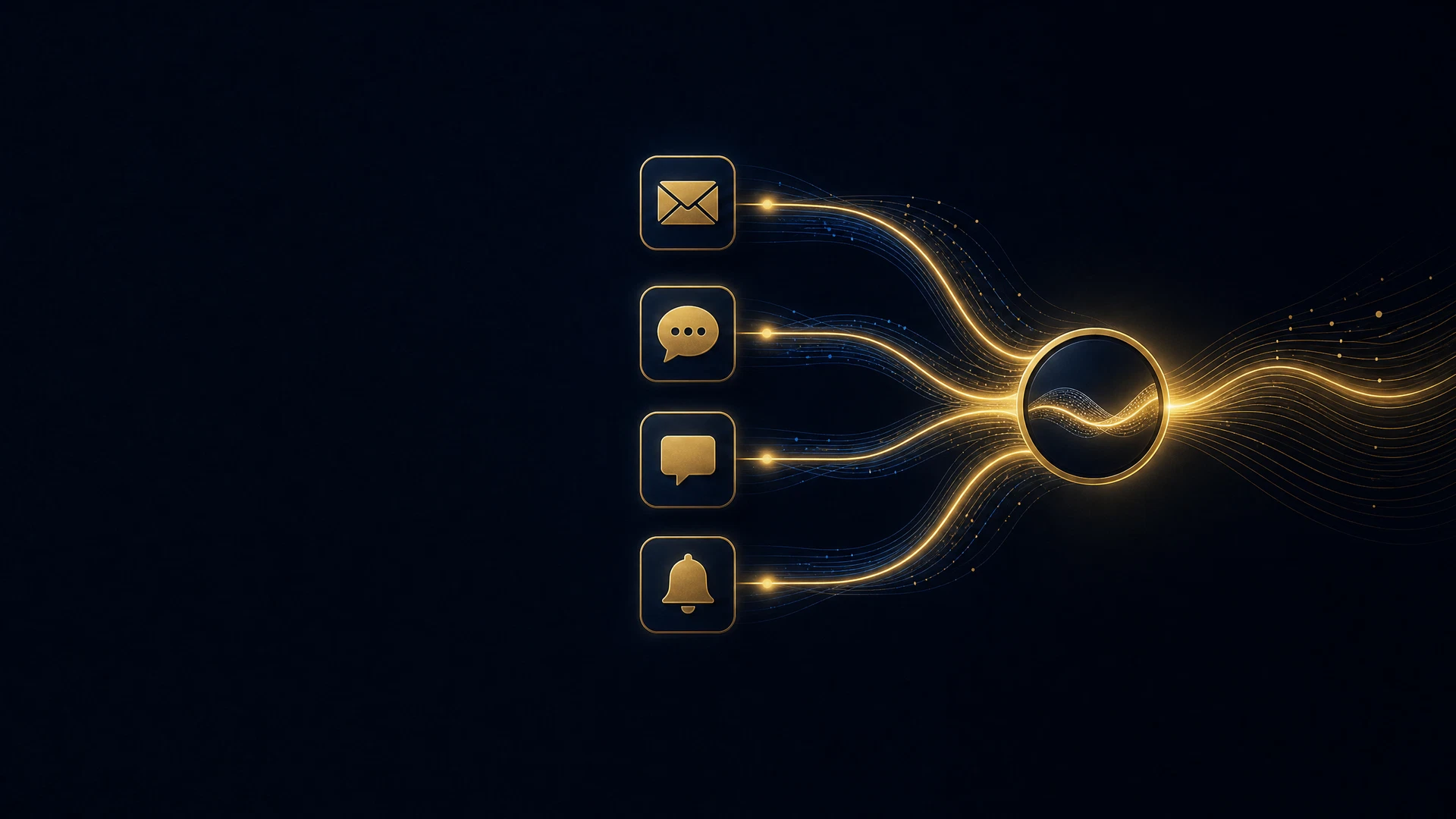
AI helps you scale personalization and decisioning across channels without writing thousands of manual rules. Instead of treating email, SMS, WhatsApp, and push as separate tactics, AI makes channel selection, timing, and creative personalization part of a single customer journey model.
Benefits you can implement (without guessing):
- More relevant sequences: AI predicts which next message or channel will most likely move a contact toward conversion.
- Consistent experience: shared customer state and suppression logic prevents cross-channel over-messaging.
- Faster optimization: AI surfaces winning subject lines, message lengths, and timing patterns for each segment.
Core components of a high-performing AI-powered funnel
1) Unified customer profile and segmentation
Build or source a single view of customer state (behavior, purchases, channel preferences). Use both rule-based segments (e.g., past 30-day purchasers) and AI-derived segments (propensity clusters). Keep segments actionable and small enough to test personalization variants.
Practical step: map 6–10 priority segments (e.g., new subscribers, high-intent cart abandoners, lapse-risk customers) and assign channel preferences and suppression rules to each.
2) Orchestration and automation
Use an orchestration layer that can run decision trees and call AI models to choose the next best message and channel. Automation should handle triggers (behavioral events), wait conditions, fallbacks, and exit criteria.
Example triggers: site visit + product view → 15-minute SMS reminder or WhatsApp message if user previously opted in; otherwise send follow-up email.
3) Deliverability and compliance hygiene
Deliverability underpins all channels. For email, maintain proper authentication (SPF, DKIM, DMARC), warm-up new sending domains, and practice list hygiene and suppression. For SMS and WhatsApp, respect opt-in/opt-out rules and use approved templates where required.
Checklist:
- Ensure SPF/DKIM/DMARC are configured for all sending domains.
- Implement double opt-in for email and clear opt-ins for SMS/WhatsApp.
- Keep suppression lists shared across channels to avoid message fatigue.
4) Channel-specific best practices
Email: design sequences with clear objectives (education, conversion, retention); use AI to recommend subject lines and personalize sections dynamically.
SMS: be concise, include single clear CTA, and time sends for recipient local time. Use SMS for urgent, high-intent nudges.
WhatsApp: prioritize conversational flows and templates for transactional or high-touch messages; route to live agents when AI confidence is low.
Push: use segmented push for short reminders or re-engagement; rely on behavioral triggers and limit frequency.
5) Analytics and measurement
Measure journeys, not just channels. Track conversions by journey (e.g., funnel completion rate), channel attribution, and cohort behavior. Combine event-level analytics (opens, clicks, session starts) with outcome metrics (revenue per journey, retention rate).
Practical metrics to track:
- Journey completion rate (start → desired outcome)
- Time-to-conversion distribution by channel mix
- Channel incrementality via holdout or A/B experiments
Practical framework: design, execute, optimize
Design
- Define the primary goal for the funnel (acquisition, purchase, retention).
- Map the ideal path across channels (email for nurture, SMS for urgency, WhatsApp for conversations, push for re-engagement).
- Identify required data signals and consent states.
Execute
- Build core templates and channel-specific variants.
- Implement AI decisioning for channel selection and message personalization.
- Configure an orchestration engine with suppression logic and fallback paths.
Optimize
- Continuously run small A/B tests (subject lines, send times, CTA phrasing).
- Use cohort analytics to understand lifetime effects.
- Retrain AI models regularly using fresh outcome data.
SEO and landing page alignment
Every outbound message should link or point to digital assets optimized for search and conversion. That means: fast-loading landing pages, clear H1/H2 that match the campaign promise, and meta information that supports organic discovery for related queries. Use campaign UTM parameters so analytics can link message-level performance to website behavior and organic touchpoints.
If you need help aligning campaign pages with on-site SEO and conversion best practices, see our solutions [blocked] and explore how an integrated approach improves both paid and organic performance.
Implementation tips for marketing teams
- Start small: pilot one AI decision for a single journey (e.g., cart abandonment) across two channels.
- Share suppression and frequency caps across email, SMS, WhatsApp, and push.
- Give live agents visibility into AI recommendations and recent customer messages to maintain human oversight.
Ready to move from planning to live campaigns? Visit Get Started [blocked] to learn the steps to launch a compliant omnichannel funnel, and read more implementation playbooks on our blog [blocked].
Common pitfalls to avoid
- Sending the same message across channels at the same time (causes fatigue).
- Treating channel choice as a one-off rule instead of a dynamic decision based on state and outcomes.
- Ignoring deliverability and consent—these erode long-term reach and trust.
Conclusion — Start with the customer, then add AI
AI-powered omnichannel funnels are powerful when they amplify a thoughtful customer-first design. Begin with clear journey goals, unify customer data and consent, and build automation that respects frequency and channel preference. Measure journeys, not just channels, and iterate using analytics and small experiments.
Practical next steps: map one 3-step journey you can automate this month, set up shared suppression lists across channels, and run a basic A/B test on subject lines or send time. If you want guided support, our solutions [blocked] team can help you design and scale automated funnels that balance AI efficiency with human oversight.